Introducing ORTEX Index Rebalance: see the forced trades before they are announced
By ORTEX
When a stock is added to or removed from a major index, every fund that tracks that index has to buy or sell it, at the close, on a known date, at almost any price. On the implementation day the stock trades 7 to 14 times its normal volume. The names are announced two to three weeks earlier, and until now most of the market first heard them from the index provider.
ORTEX Index Rebalance moves that moment forward. It is a daily forecast of index additions and deletions for 131 indices in 22 markets, built from the same point-in-time data behind the rest of the platform, and scored every day against what the providers actually announce. It is available now, as an add-on to ORTEX Advanced.
Three numbers on every name
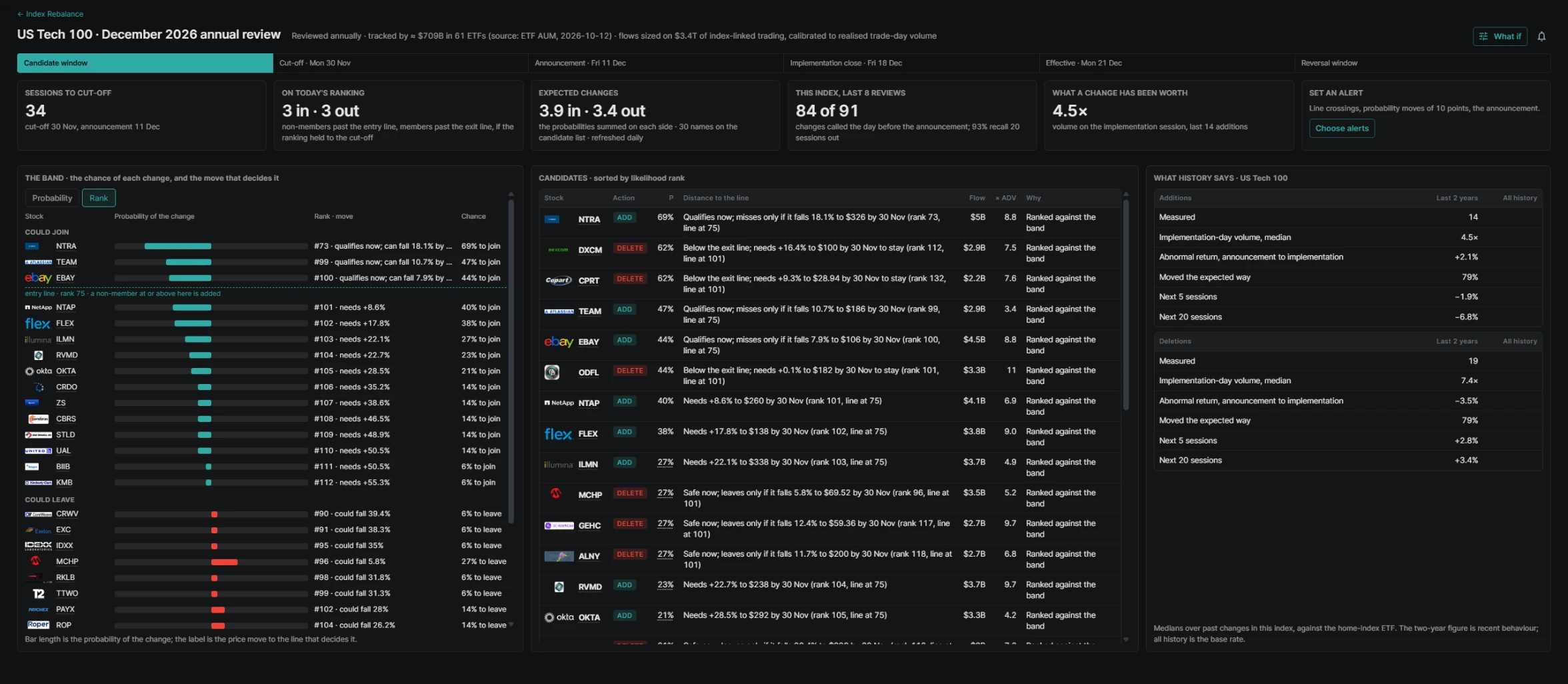
Index Rebalance is built around three figures, because those are the three things you need to decide whether a name is worth your attention.
- The probability. The chance the stock joins or leaves at the next review, as a percentage, refreshed every trading day. When ORTEX says 30%, about three in ten such calls come true, and the track record page shows the figure for every band.
- The move it needs. Most reviews are decided by a ranking on a cut-off date. For every candidate, ORTEX shows where it sits against the line that decides the call, in rank and in price: "needs +4.8% by 1 December", or "qualifies now; misses only if it falls 8.2%".
- The flow. How much index funds will have to buy or sell if the change happens, in shares, in currency and in days of the stock's own volume. A 40% call on a name with eight days of volume to absorb is a bigger trade than a 95% call on half a day.
What is in the product
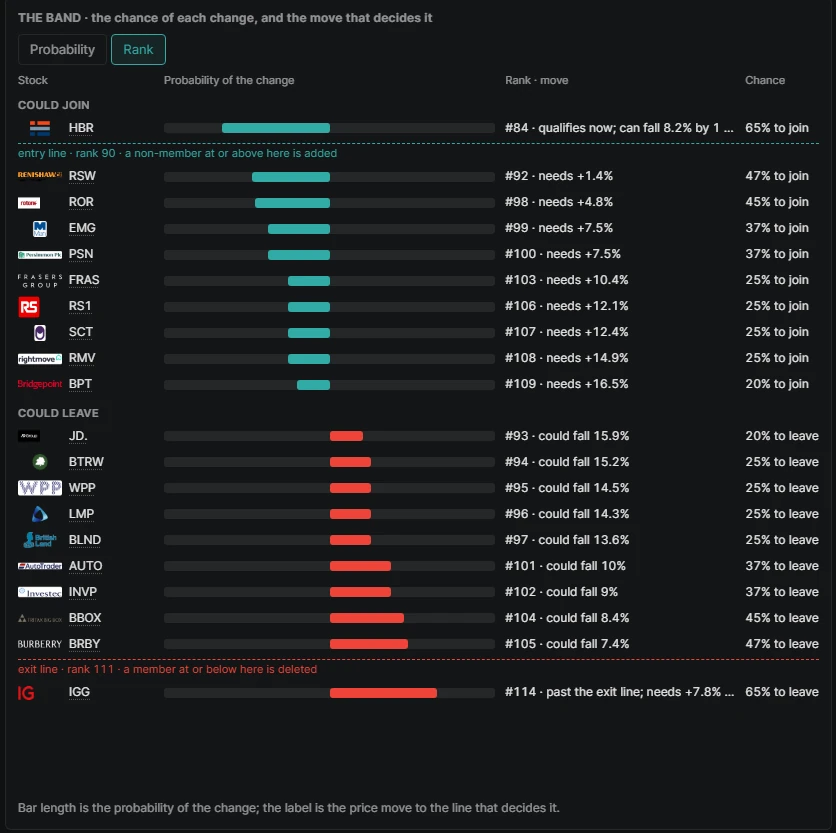
Radar: the trades not to miss
The Radar lists every live forecast across all 131 indices and ranks it by expected forced volume: probability times days of the stock's own volume. It is the shortest answer to "what matters this month", and it can be re-sorted by dollar flow, by probability or by date.
Review pages: one review, one screen
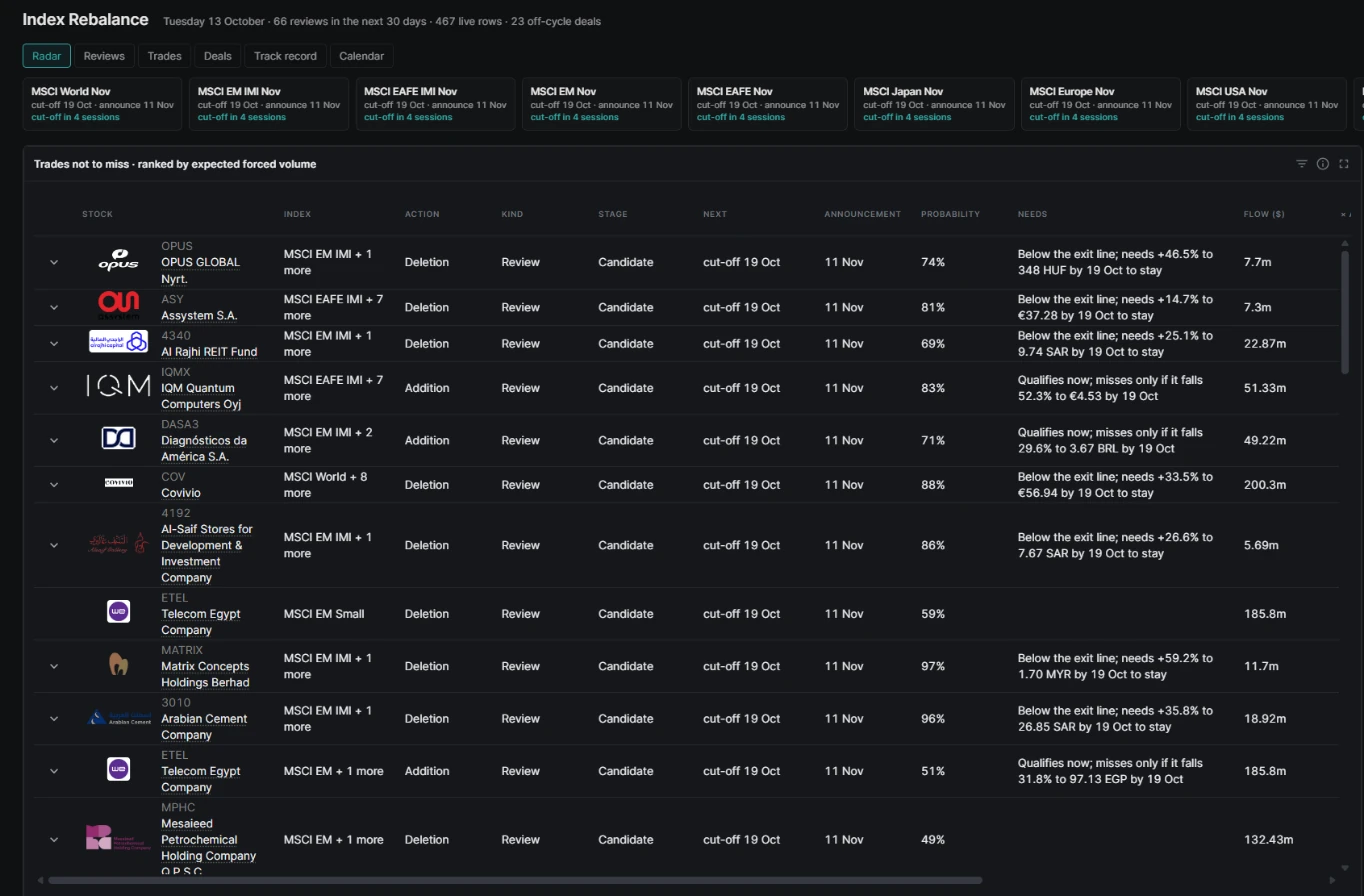
Every scheduled review has its own page: the four dates and the countdown, the assets tracking the index, today's ranking against the line, the expected changes, and the band. The candidate list carries the flow and the distance to the line for every name, and a history panel shows what the last changes in this index did to volume and price, over the last two years and over all history.
Trade pages: the whole case for one name
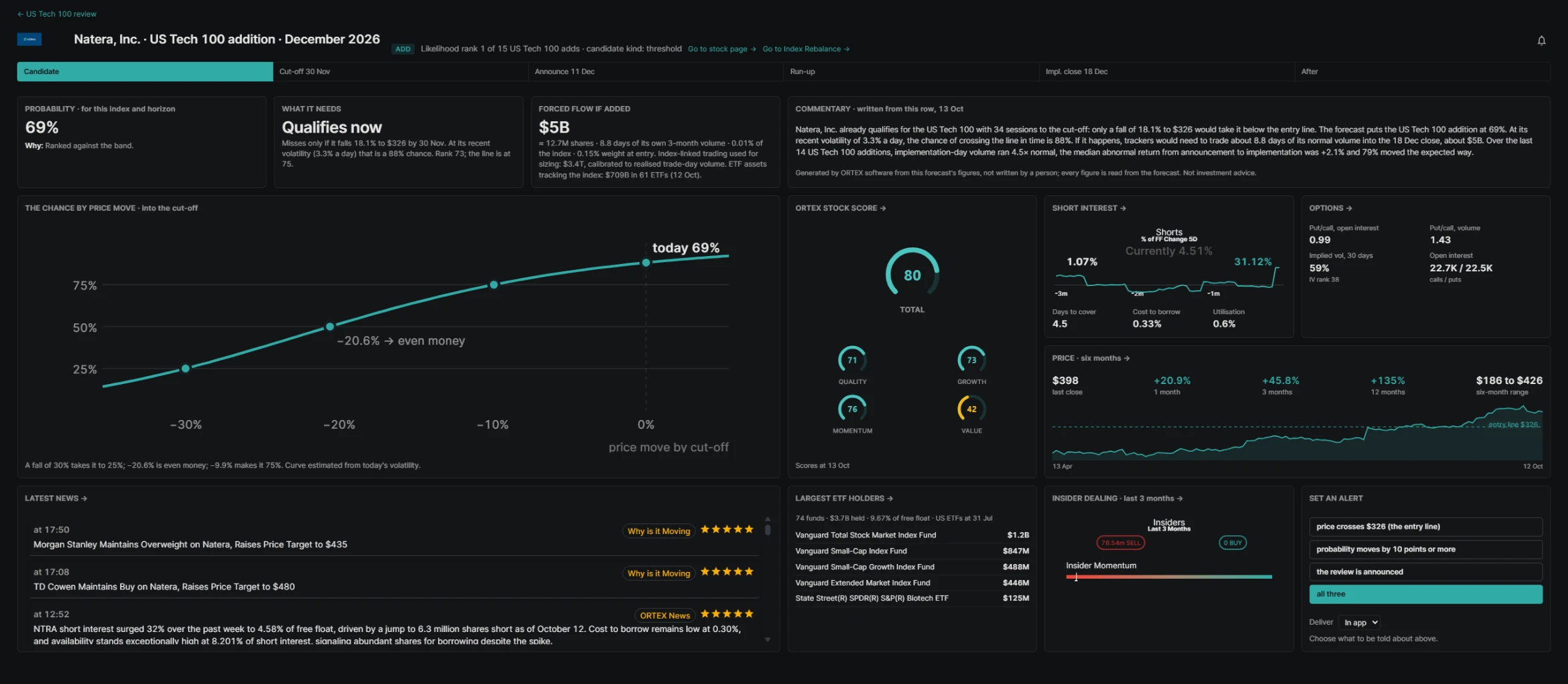
Open any candidate and the case is on one page: the probability and why, what the name needs by when, the forced flow if it happens, a curve showing how the odds change with the price, and the context you would otherwise open five tabs for: the stock score, short interest, options, the largest ETF holders, insider dealing, recent news and the six-month price with the line drawn on it. A short written commentary pulls the figures together.
What if: move the prices yourself
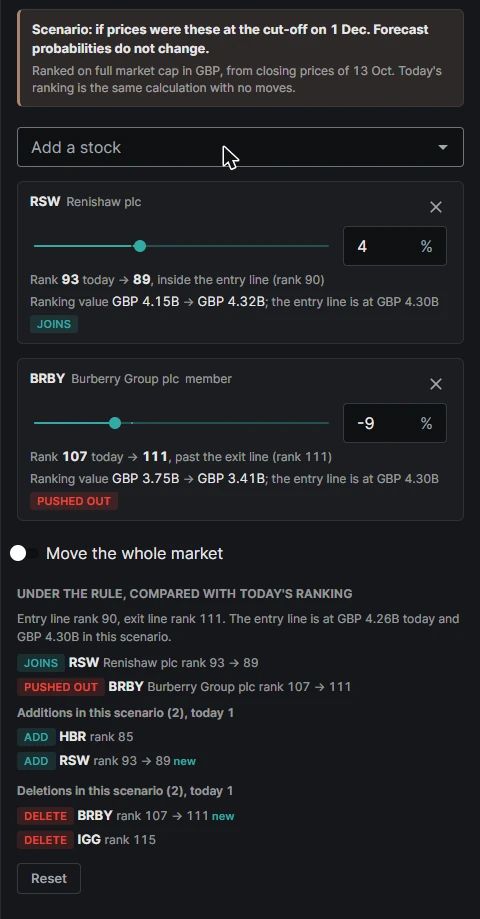
Most reviews are decided by a ranking on the cut-off date, so the question traders actually ask is "what has to happen for this name to make it". The What if panel on each review page answers it directly. Pick any stock, move its price, or move the whole market, and the page re-ranks the index under the provider's own rule: the new rank, the ranking value against the line, and the additions and deletions that would follow, marked against today's list. A name four percent higher crosses the entry line and a member nine percent lower drops past the exit line, with every other candidate re-ranked around them. It is a scenario, not a forecast; the probabilities stay as they are, and the panel says so.
Deals: the off-cycle half
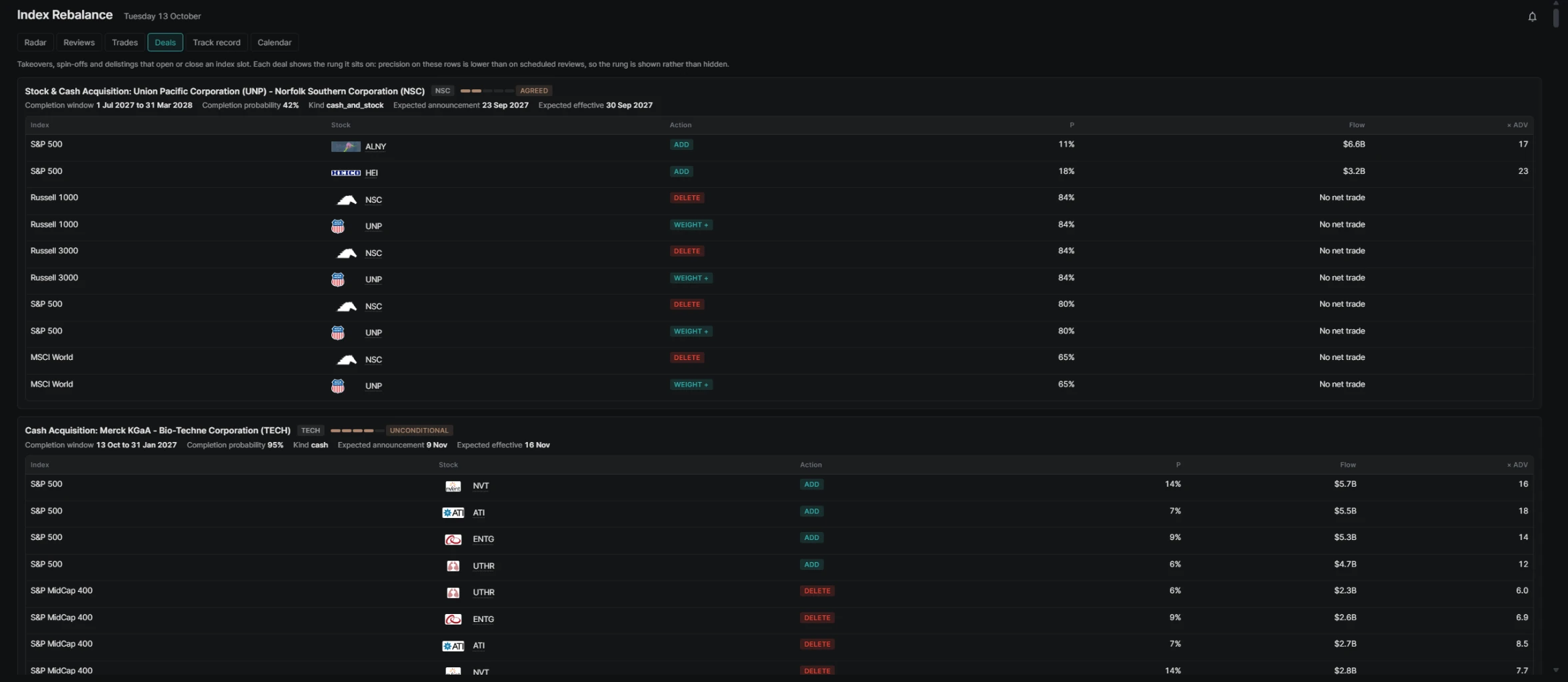
Not every index change waits for a review. Takeovers, spin-offs and delistings open and close index slots all year. The Deals view lists every pending deal that touches a covered index, with its completion window and odds, the deletion it causes, the replacement where the provider names one, and the tracker flow on every leg.
Alerts, a morning brief and a calendar
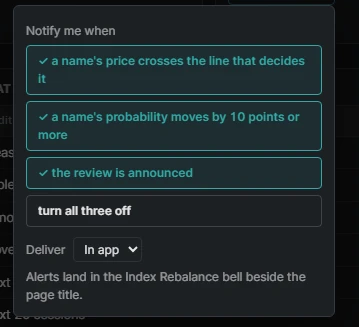
Set an alert on a review or a single name and hear when a price crosses the line that decides a call, when a probability moves by ten points or more, or when the provider announces. A short brief is written every morning from the latest forecasts, so the day starts with what is inside 30 days, what moved overnight and which deals are close. The calendar lists every upcoming review with its cut-off, announcement and effective dates and the assets tracking each index.
The track record is part of the product
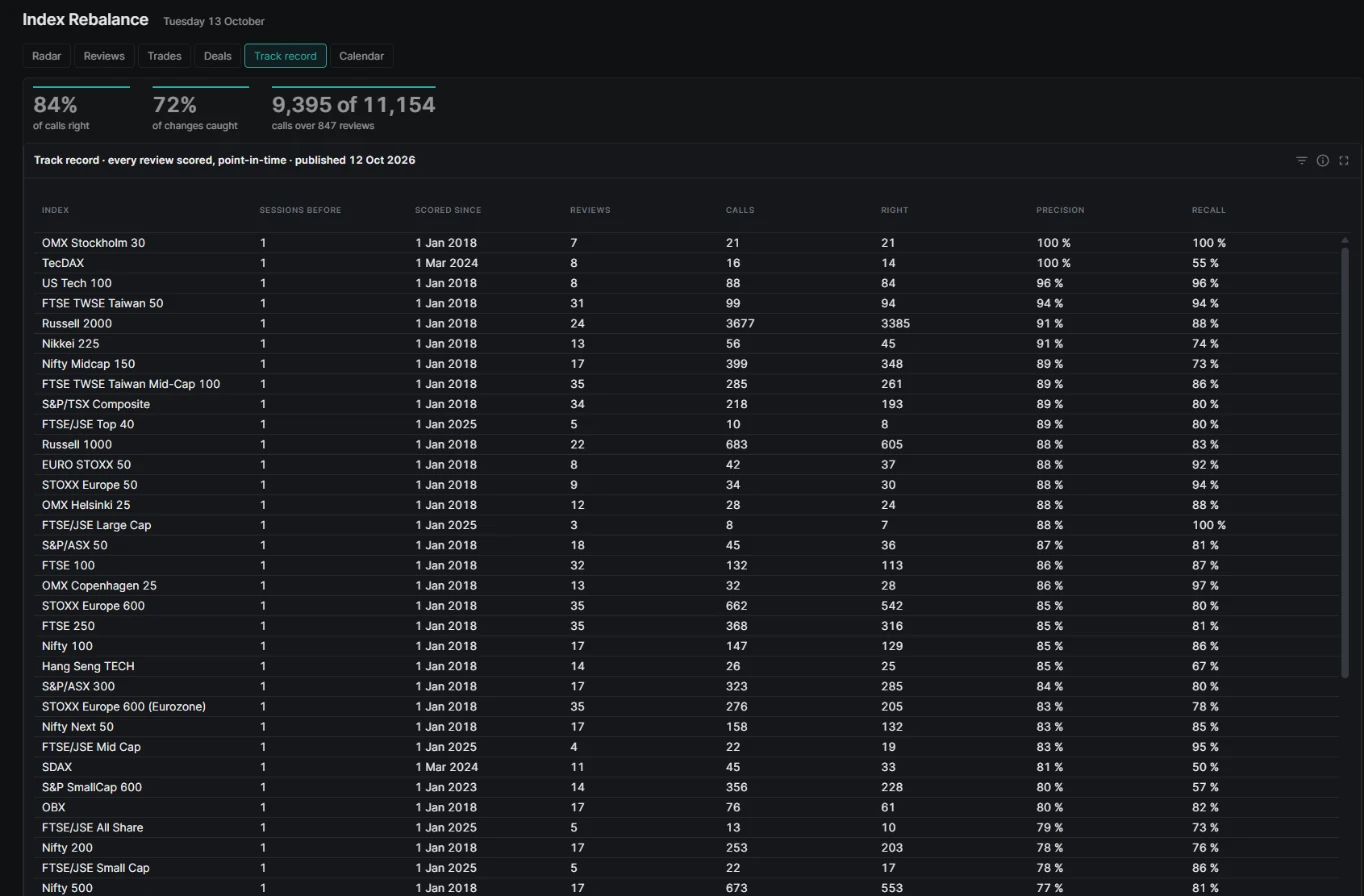
Every forecast is kept point in time and scored after the announcement, and the scorecard is published inside the product and on the public track record page. A call counts when its probability was 50% or more, and it is right when the named stock was added or deleted at that review. Weak cells are shown next to strong ones.
85% of calls right the day before the announcement, every scheduled review since 2018 across 46 indices | 82% already right three weeks before the announcement | 12,141 calls scored against 12,808 official changes |
What we sell, plainly: the price effect of an index change is small, skewed and has shrunk over the years. The volume effect is large and stable. Index Rebalance tells you who must trade, when, how much and how likely. What you do with that is your decision, and nothing in the product is a promised return.
Coverage
131 indices in 22 markets, refreshed every trading day before the open. The main large-, mid- and small-cap benchmarks of the United States and Canada; the United Kingdom, the euro area, Germany, France, Italy, the Netherlands, Belgium, Ireland and Switzerland; the four Nordic markets; Japan, Australia, Hong Kong, Taiwan and Korea; India and South Africa; and the global developed- and emerging-market families with their country and size indices. Rules-based indices, committee-selected indices and off-cycle deal changes are all covered.
Availability and pricing
Index Rebalance is available today in the ORTEX app as an add-on to ORTEX Advanced, at $99 a month or $799 a year, shown in your local currency where available. For the launch, monthly subscribers get 50% off their first three months. Advanced subscribers already see the index calendar, the announced changes, the track record and the headline of the daily brief; the add-on unlocks every forecast, the Radar, the review and trade pages, the deals, the alerts and CSV export of the current forecast.
For desks that need the data in their own systems, the desk plan from $497 a month adds the API with the extended columns, daily files, webhooks for alerts and point-in-time forecast history from 2018 for backtesting. Bulk delivery, custom universes and redistribution are licensed through data sales.
See today's Radar, the next reviews and the full track record.
Open in the ORTEX app → See the track record
Index rules are set and owned by the respective index providers. ORTEX forecasts are estimates of future index actions, not official index actions, and nothing on this page is investment advice. Track record figures are as published on 12 October 2026 and are updated after every review. Screenshots were taken in the ORTEX app on 13 October 2026; the names shown are the forecasts of that day and will have changed since.
See ORTEX data live.
The same proprietary data behind this article, on the platform, by API and in Excel.
Try ORTEX free →